Riisitunturi. Autumn.
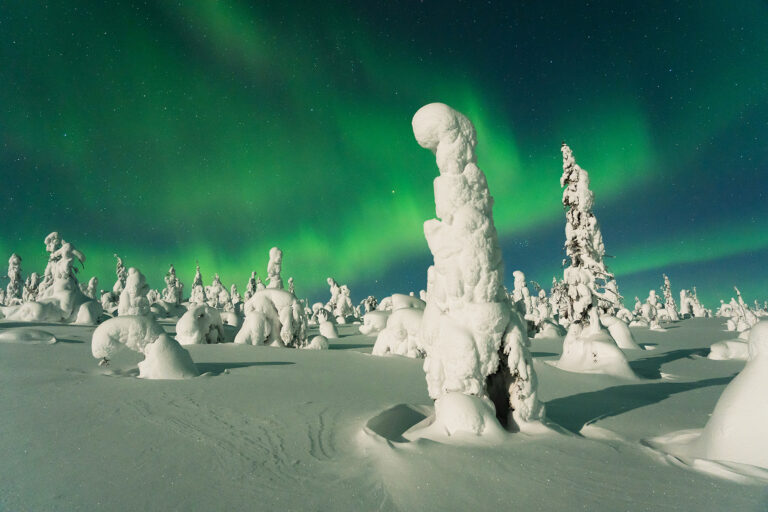
Many will probably have happened to see the wintery Riisitunturi with its slender spruces covered in snow and rime frost, which feature both in photographs and even numerous nature films. However, the other seasons, including autumn, receive undeservedly little attention. The very end of autumn can also look quite wintery.
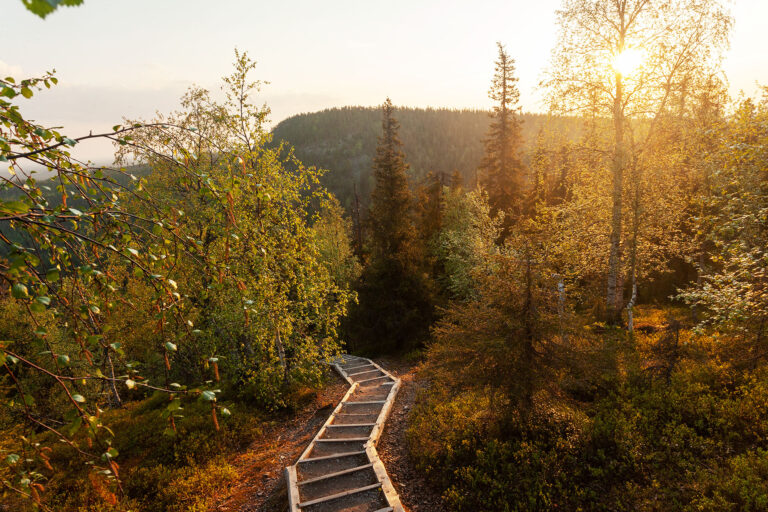
Whatever the season, it can be noticed that visitor numbers are constantly rising. As a little hint, according to my observations, from spring to autumn most visitors set out on the trails around 10 in the morning and leave between 3 and 4 in the afternoon. This is plenty of time for many to complete the 10.7-kilometre Riisitunturi trail. Therefore, during the nicer light, in the morning before 10 and in the late afternoon, it is quite quiet.
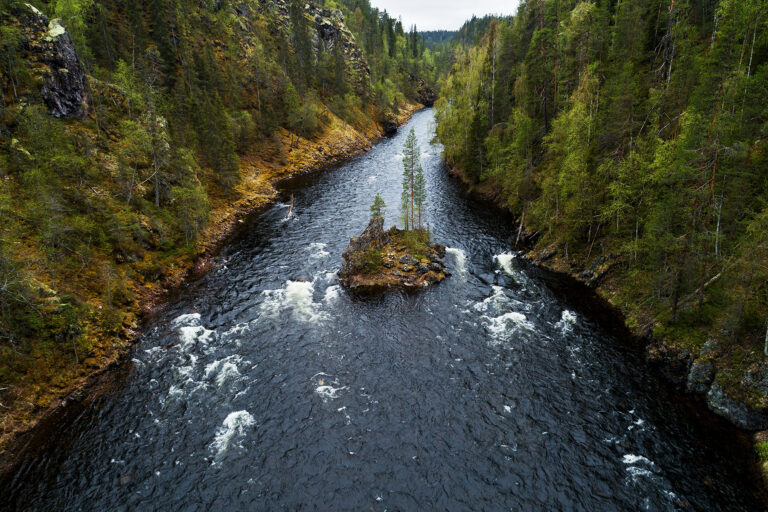
The attraction of Riisitunturi is nature itself. How trees grow, die and how new trees grow in their place. A continuous cycle in which humans have not directly interfered. Small pools, slope bogs, former marshland meadows with hay barns, cabins and shelters, and even the little Riisijoki river are some of the key features to keep in mind during the trip.
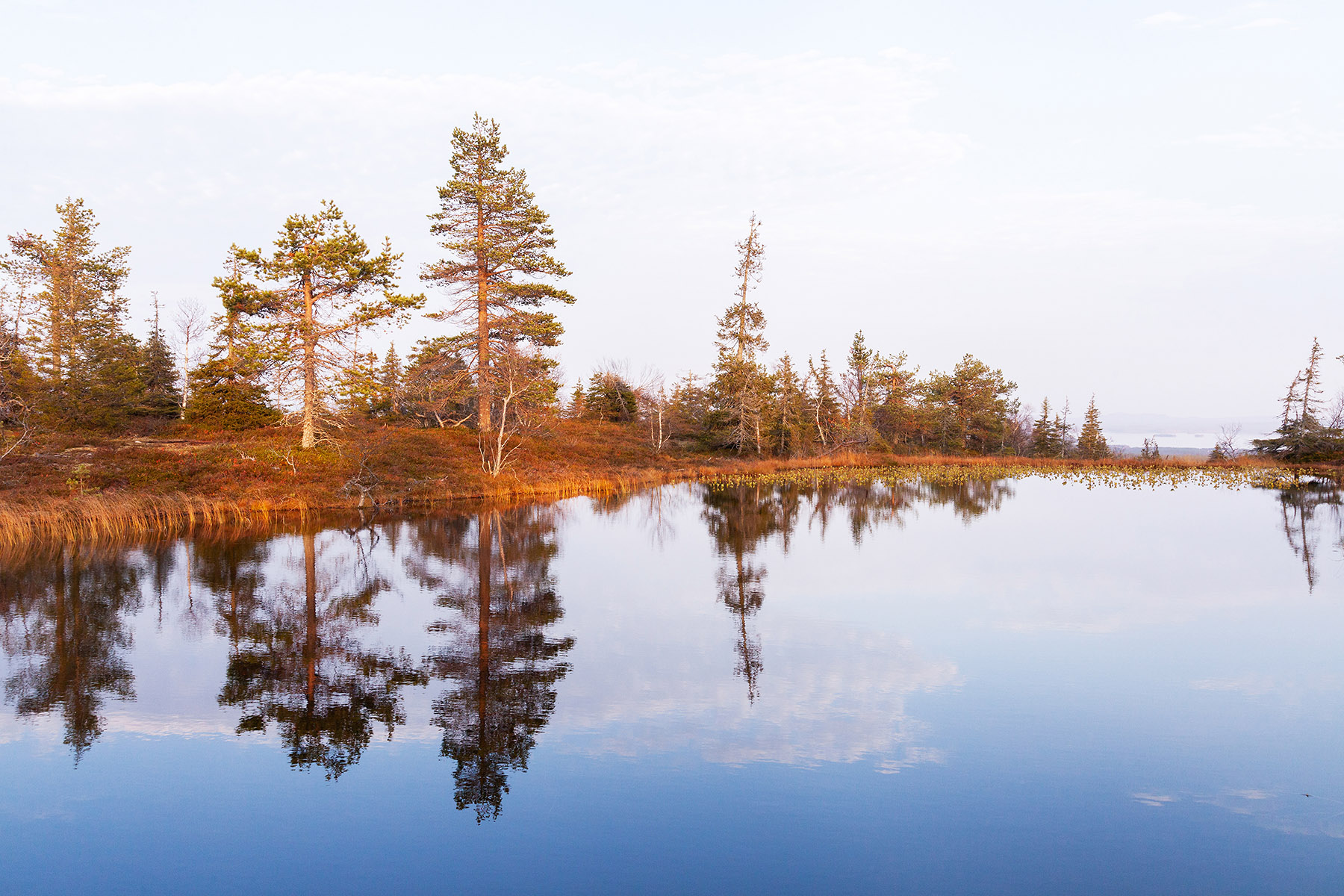
Between Riisitunturi and Pikku Riisitunturi, close to the roughly 4.3-kilometre-long Riisin rääpäsy trail loop, lies the small tarn of Ikkunalampi. Mostly I have been able to observe the water's surface on calm days when it is as smooth as a mirror and captures the reflections of the surrounding plants. Then the feeling increases even further, as if the tarn were situated at the edge of the world. If the sky happens to be bright blue as well, the tarn seems to intertwine with the sky as one. At a quieter moment, when there aren't overly many people bustling about in the surroundings, one can sit down on the somewhat rustic bench by the water and let oneself be mesmerised by the view. The question may certainly also arise in one's mind as to how it doesn't drain of water.
With a similar amazement, one can look at the patches of bog located in Riisitunturi, which even cover the slopes and somehow do not lose their moisture, despite being crossed by numerous tiny streams. Riisitunturi is indeed known for its hanging bogs, which are among the most representative not only in Finland but also in Europe, and were decisive in the establishment of the national park. In the national park, one can spot some of the steepest hanging bogs in the world, dotted with pines, tiny spruces, and various species of birch.
Bogs winding along the slopes, centuries-old coniferous forests and numerous ridges create a photogenic landscape where light and shadows constantly alternate. Bluish shaded areas are particularly striking. Although I like Riisitunturi in summer and even in winter, when the national park is visited in large numbers because of the snowy spruce candles, my favourite season is autumn, especially the autumn colours, *ruska* in Finnish. Russian Time.
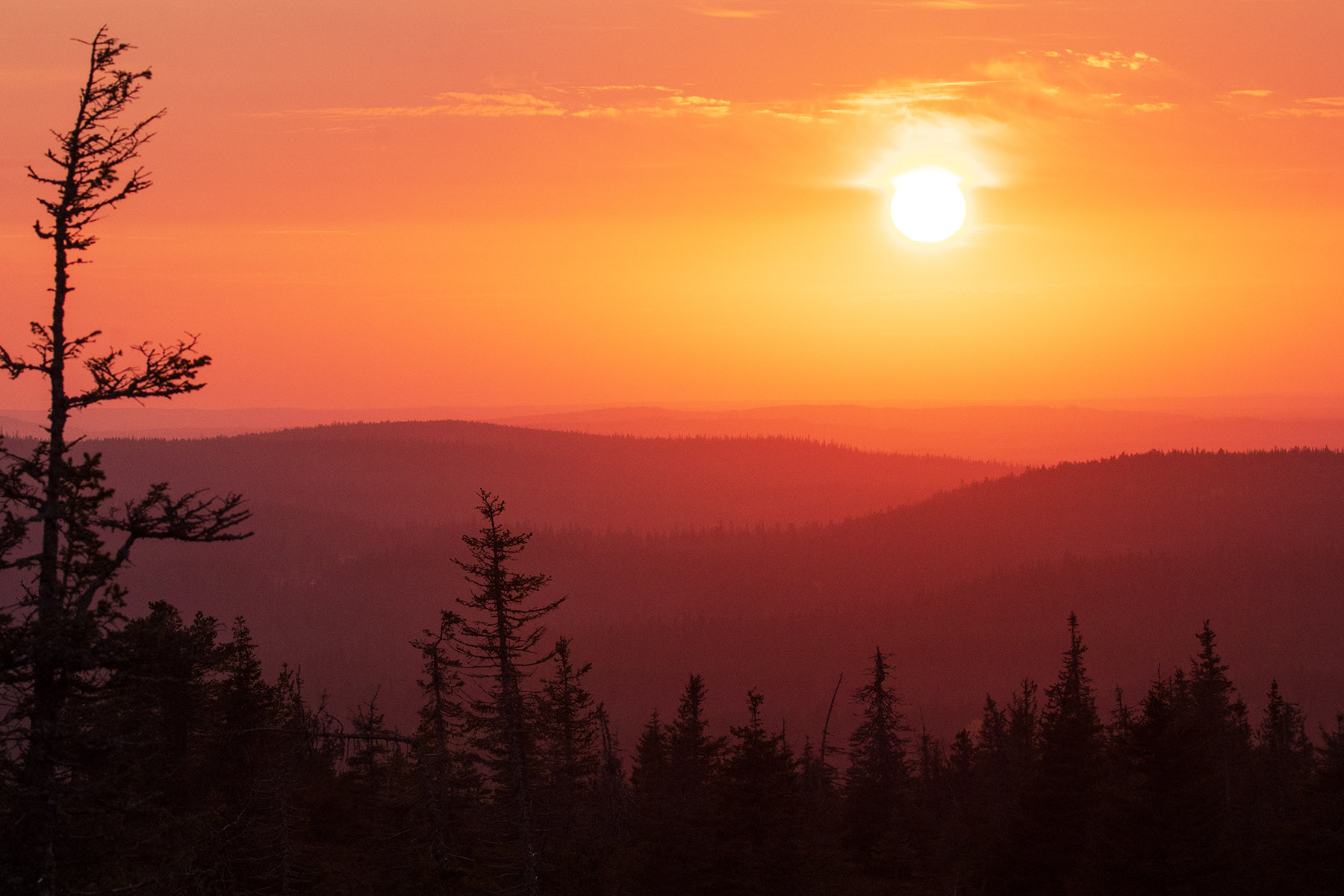
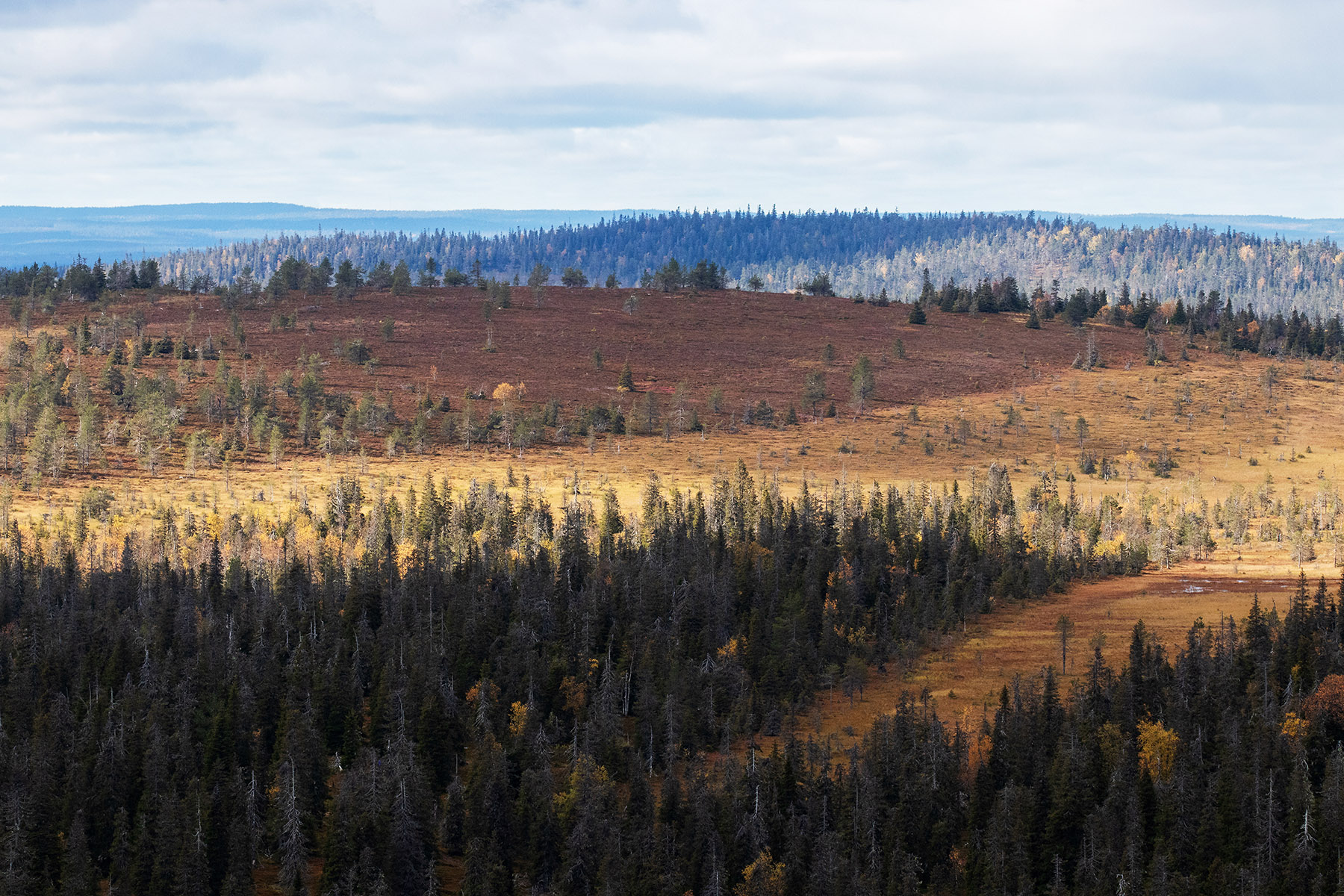
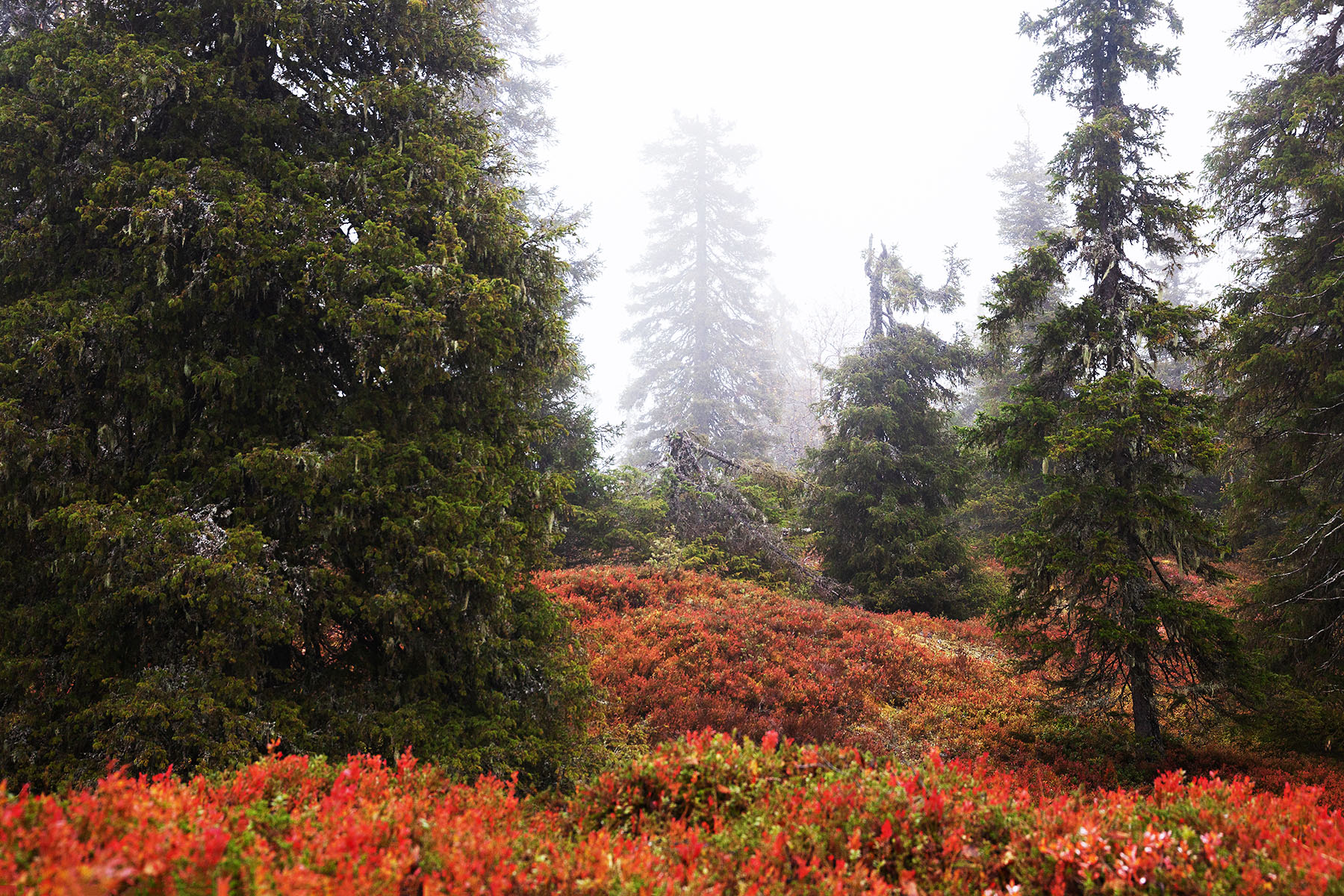
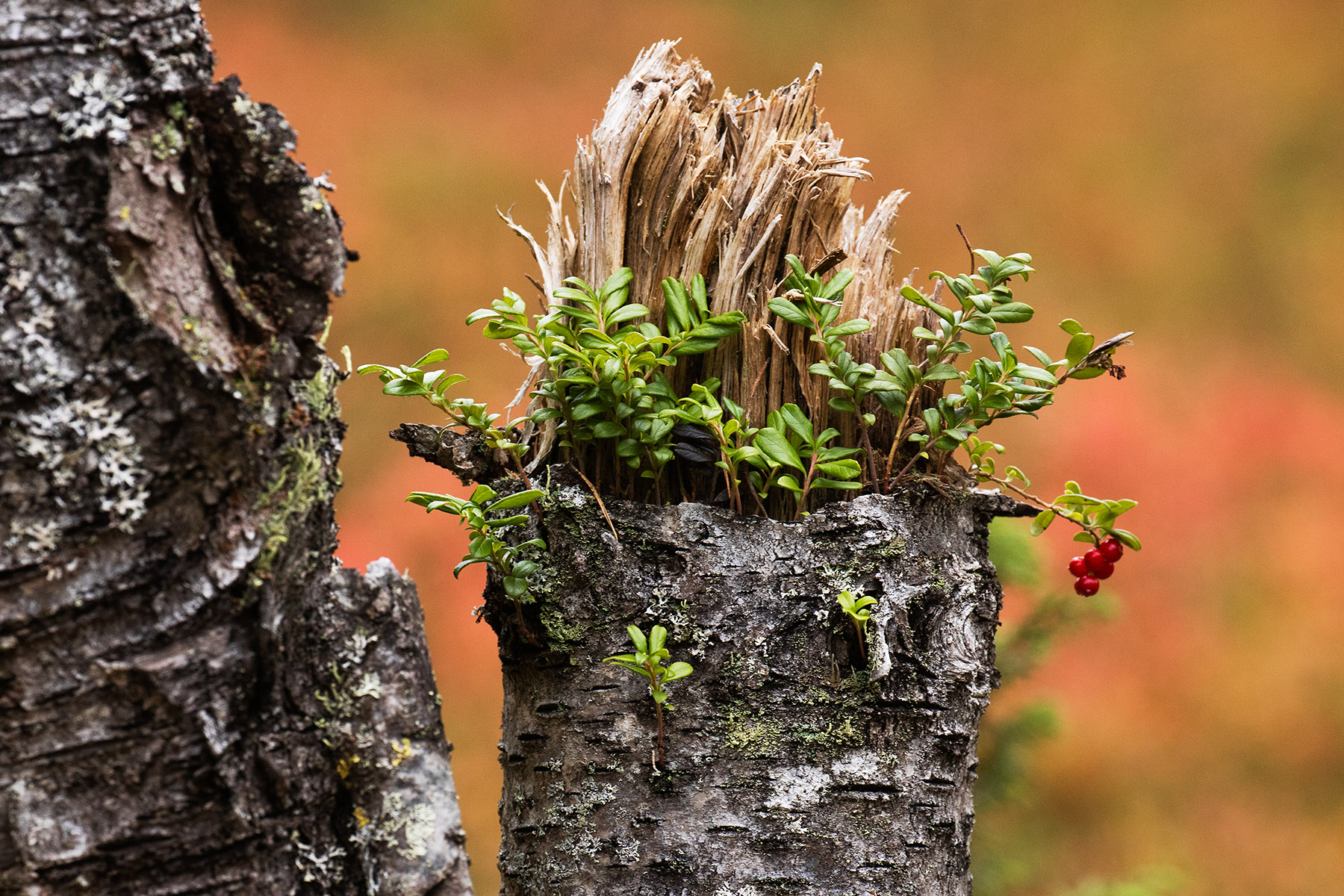

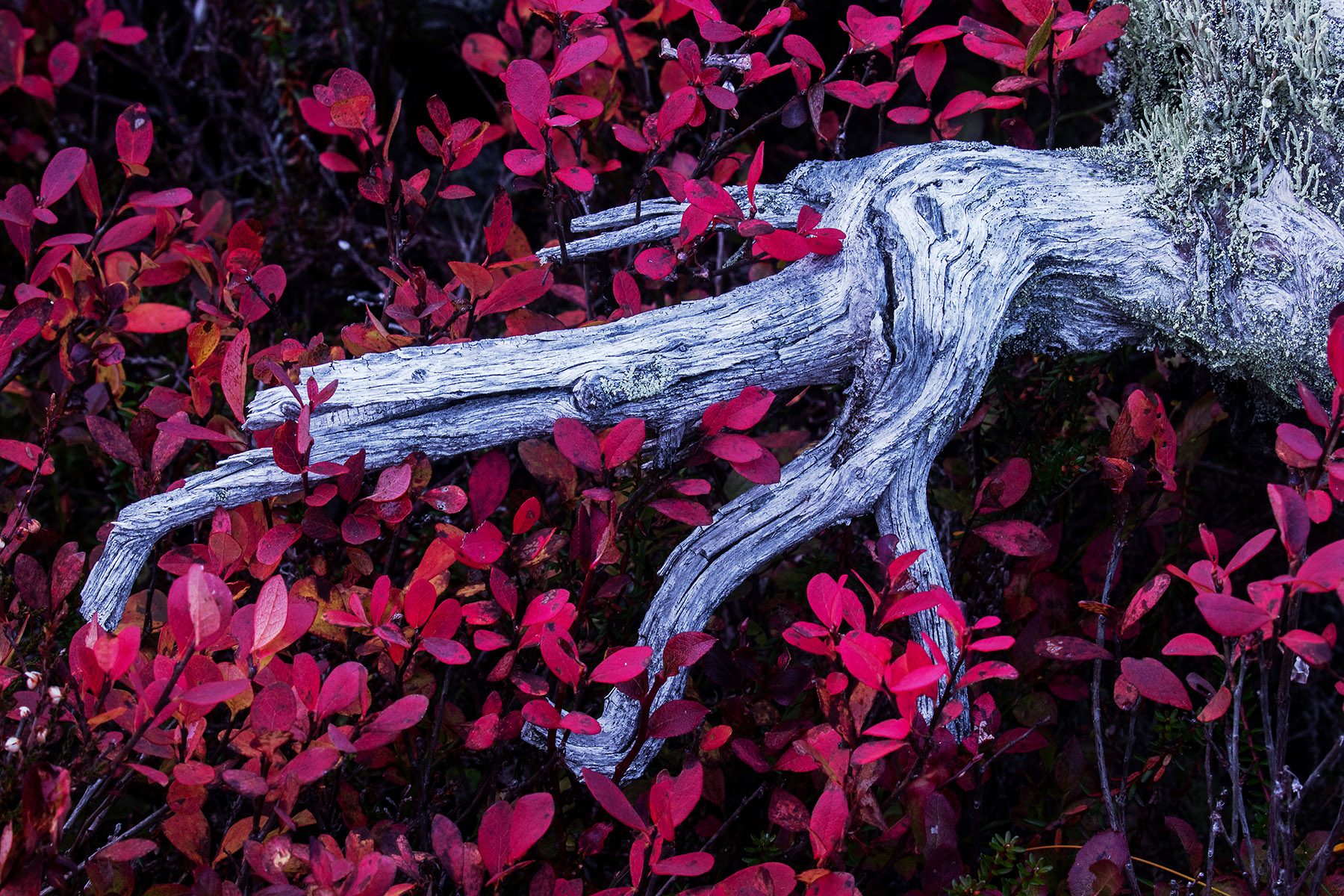
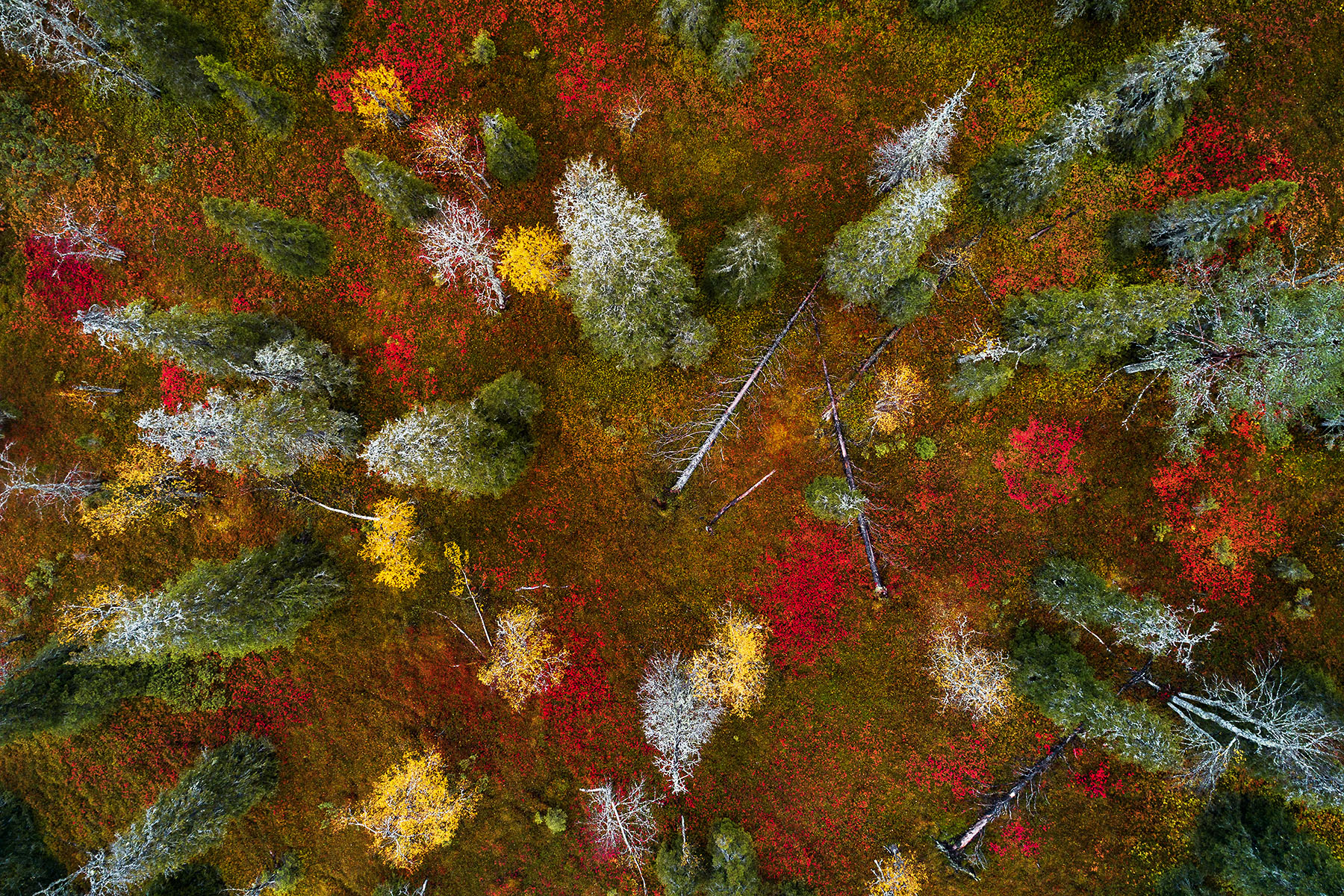
Mostly, I have aimed my visits to Riisitunturi for the period from mid-September to the end of the first week of October. Depending on the year, this is precisely when the autumn colours tend to burst into life. The colours are brought to the landscape not only by yellowish birches, willows and aspens, and reddish rowans, but also by the vegetation covering the bog patches, among which are various peat mosses. Across the undulating landscape, bilberries, dwarf cornels, alpine bearberries and bog bilberries paint the plant carpet red. In some woodland nook, the latter can create the feeling as if one were walking on a pinkish-purple carpet that insidiously drops tiny leaves into one's footwear.
Autumn weather
The weather at Riisitunturi is rather changeable in any season. A distinction should be made between the weather in the more forested zone, which is located at the foot of the ridges, and the weather on the ridges themselves. This can differ noticeably. Firstly, it is almost always windy higher up, even on calm days. In addition, it seems that moisture plays a role there too. Thus, one can experience a variety of weather while moving around Riisitunturi.
All autumn trips to Riisitunturi have been very varied. I have been treated to both strong winds, early frosts and even snowfalls, as well as summer warmth. Even when visiting Riisitunturi on different days of the same trip, it greets you in different moods. Mostly, the mornings and evenings, not to mention the nights, are already quite chilly from the second half of September onwards, so it is worth dragging along rather more clothes than fewer. Although the first snowfalls can be encountered as early as summer, more commonly at the end of September, the heavier snowfalls happen in October and certainly already by November.
Just the changeable weather brings a unique quality to the opening views, which, after the loss of leaves and the consequent fading of colours, momentarily seems to vanish. September storms can cause dismay, as they effortlessly strip leaves from trees and even bushes. Even after excessively cold nights, so many leaves fall that this shedding can actually be heard with the ear.
What I find particularly special, however, are the autumn mists, which can linger for several days on end. The leaves on the trees make these mists more vivid, and the damp spruce forests take on a mystical air. If you’ve ever stored the sweeping views of Riisitunturi in the recesses of your memory, then I’d also recommend taking in the mists of Riisitunturi.
Autumn birdlife
As a keen birdwatcher, I can tell you that, from July onwards, Riisitunturi is a relatively quiet place in terms of birdlife. There is no ceaseless song of blackbirds and fieldfares ringing out incessantly amongst the tall, slender spruce trees. However, one shouldn’t assume that the place is bird-free in autumn. Nevertheless, Riisitunturi has surprised me over the years. It is, in fact, a relatively undisturbed area offering a variety of habitats, apart from the activity around the trails – yet it lacks the abundance of birds found in some of the other nature reserves in the vicinity. For example, the old spruce stands on the summer slopes of Riisitunturi do not resound with the song of the blue tit, even though they seem ideal to my eye; the willow grouse gliding amongst the gnarled spruce trees and accompanying hikers are rarely seen, and even the taiga flycatchers, for whom these forests would be perfectly suited, are rather few in number.
I have nevertheless been fortunate enough to see the latter in the landscapes of Riisitunturi. For several fine, sunny autumn days I walked in step with a small tit flock consisting mainly of grey-headed and Siberian tits. The Siberian tits, significantly larger than the others, constantly dropped amidst the bright red bilberry and pink bog-bilberry bushes to pick small insects from there. Neither species knew to fear humans at all, and on more than one occasion the brownish-looking Siberian tits were closer to me than half a metre.
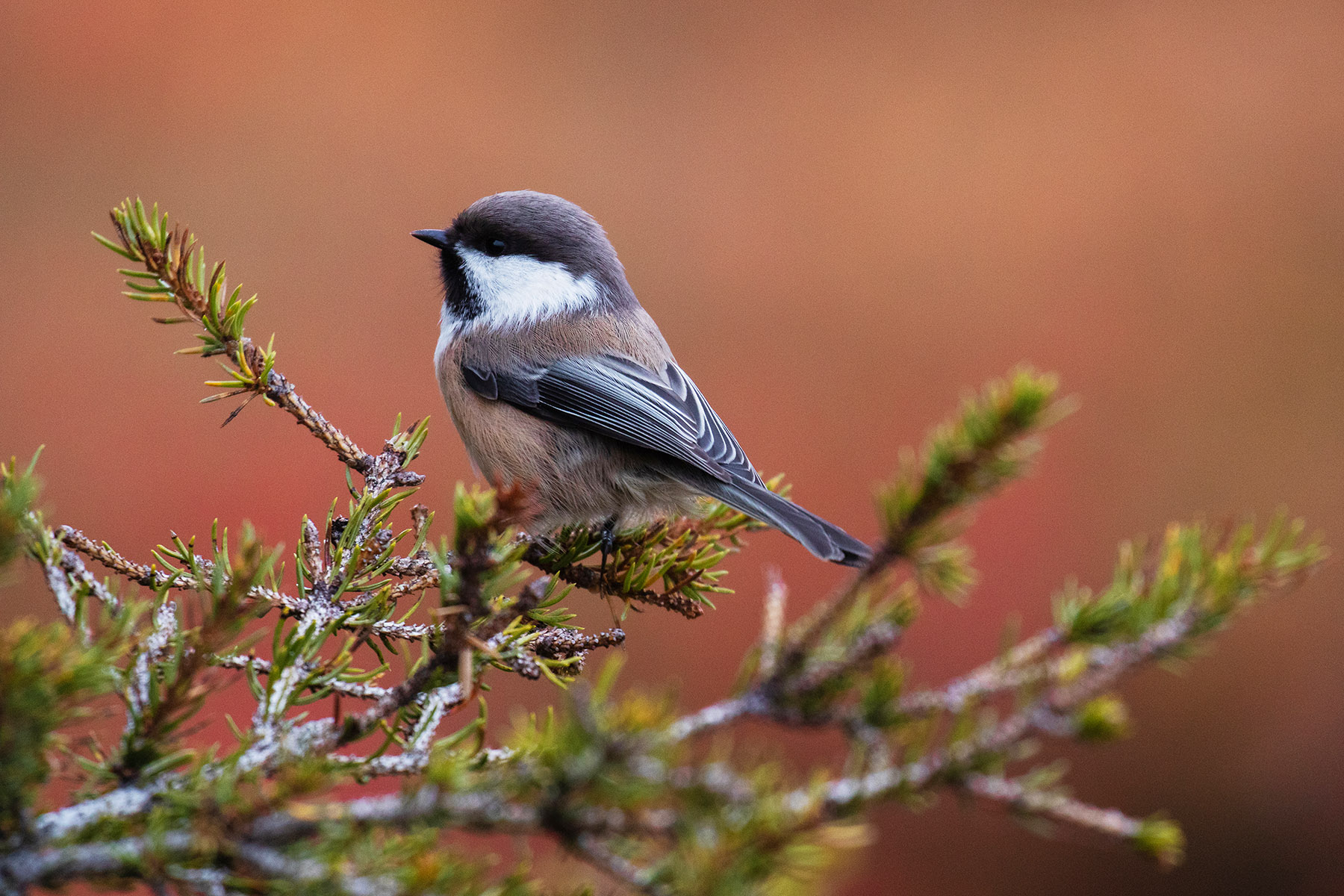
Although taiga titmice are slightly larger than other titmice, they are almost as nimble, if not more so. As they have to endure the harsh winter, having food stores is vital for them, and so they spend most of the daylight hours foraging for and storing food. The best time to spot taiga tits in Riisitunturi seems to be in autumn, when you can also come across plenty of young birds.
During the summer months, the silky-tailed warblers feel right at home in Riisitunturi. They nest quite late, rarely before June, so as to wait for the summer berries to ripen – both the adult birds and their chicks in the nest need these, alongside insects. I have even spotted adult birds building nests in the first few days of July, and rather scruffy-looking young birds in September, which, judging by their appearance, looked as though they had only just left the nest.
On a chilly autumn or winter day, a waxwing can eat up to a thousand berries, roughly equal to twice its body weight. Although in winter Riisitunturi is thickly covered in both rime and snow, meaning one might not even find those few rowan clusters that could remain from autumn, many autumns in Riisitunturi are nevertheless extremely rich in berries, and various berries can be found even when a dearth of forest yields prevails in the surrounding woods. Yet, in autumn one does not very often encounter waxwings filling themselves with berries in Riisitunturi, even though one would expect young birds to operate there for a little longer. They can be spotted more in flight or pausing on trees for a moment to move towards larger settlements where plenty of rowan berries are to be found.
Since the area is also large, numerous flocks of birds may busy themselves in those corners of the national park where people rarely venture. Pine grosbeaks are slightly less disturbed by the presence of humans, and may focus on snapping up various buds and berries in one spot. Lingonberries, bilberries, crowberries, and bog bilberries all attract special attention. I have repeatedly encountered these winged creatures amidst the more forested slopes of Riisitunturi. They do not very often have business at the summits of the heights. Although pine grosbeaks are not particularly afraid of an approaching biped, they have a weaker connection with quadrupeds, especially those that have tramped the trails with humans.
The ever-increasing visitor numbers seem to be pushing birdlife further and further away from the trails of Riisitunturi. Dogs, which are generally kept on leads, keep the local wildlife on edge. I have been surprised, however, by how many grouse still dare to stay close to the trails and only take flight with a whirr at the very last moment. Until that moment, they try to go about their business and, when a person or dog appears, stay hidden beneath bushes and lower branches.
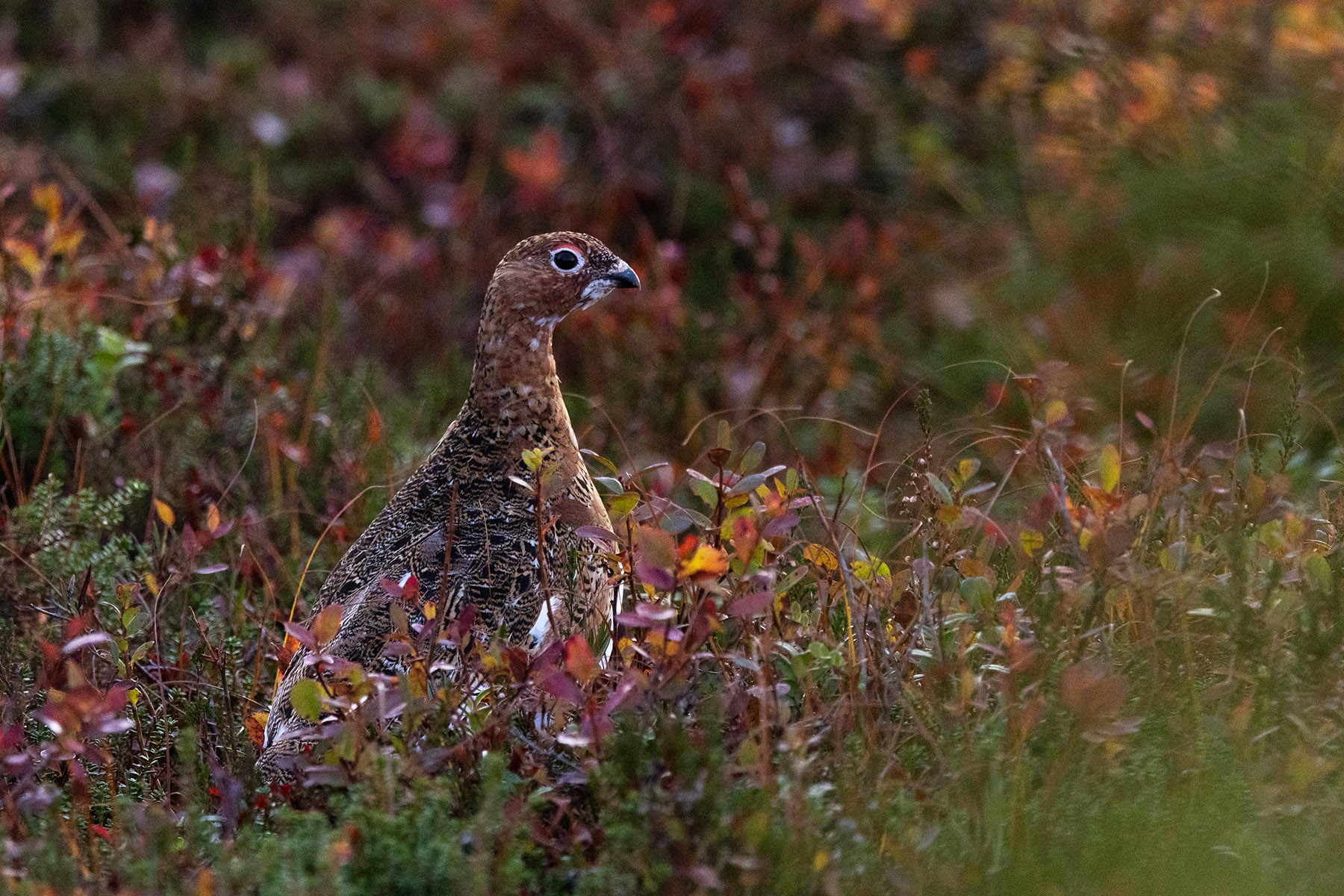
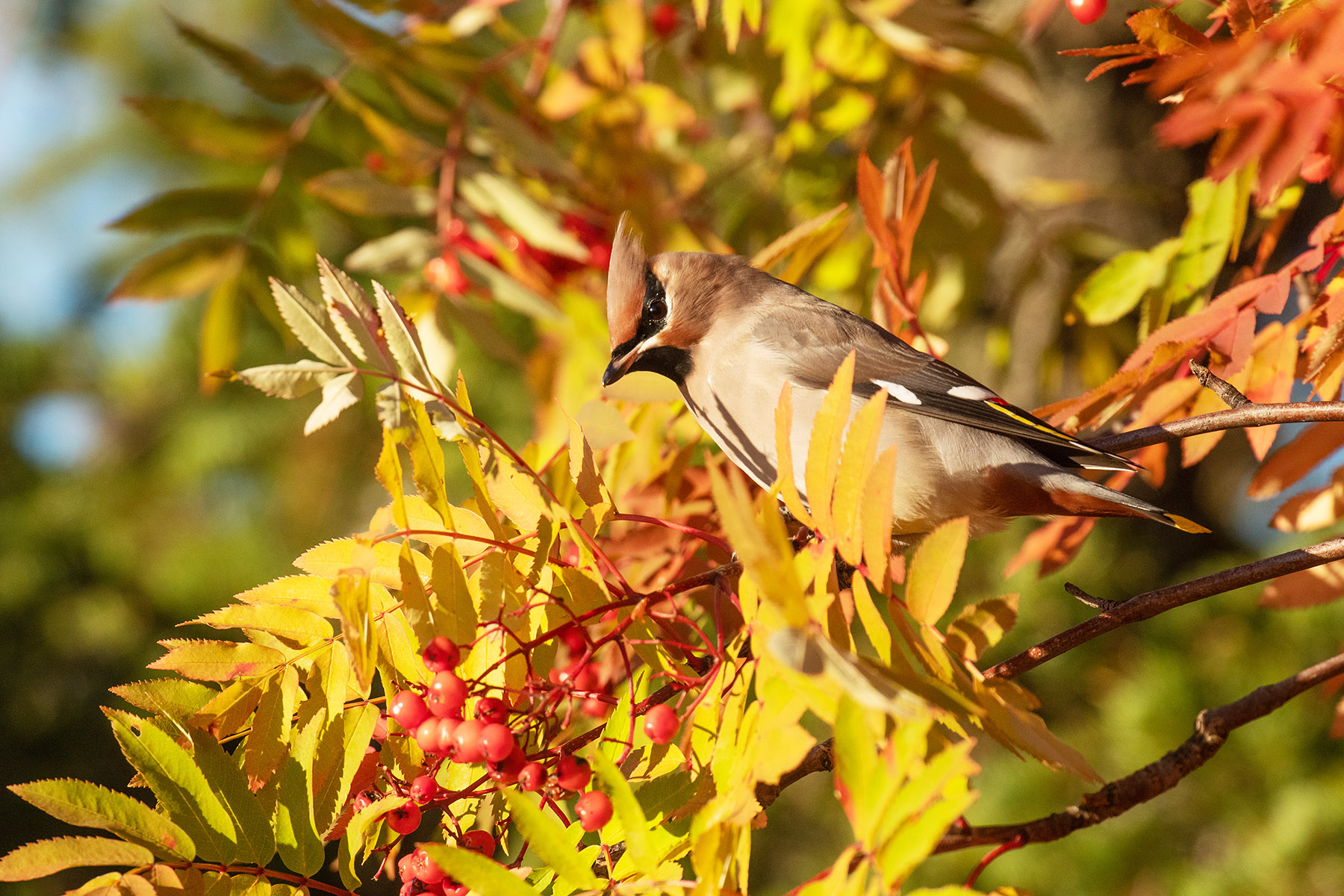
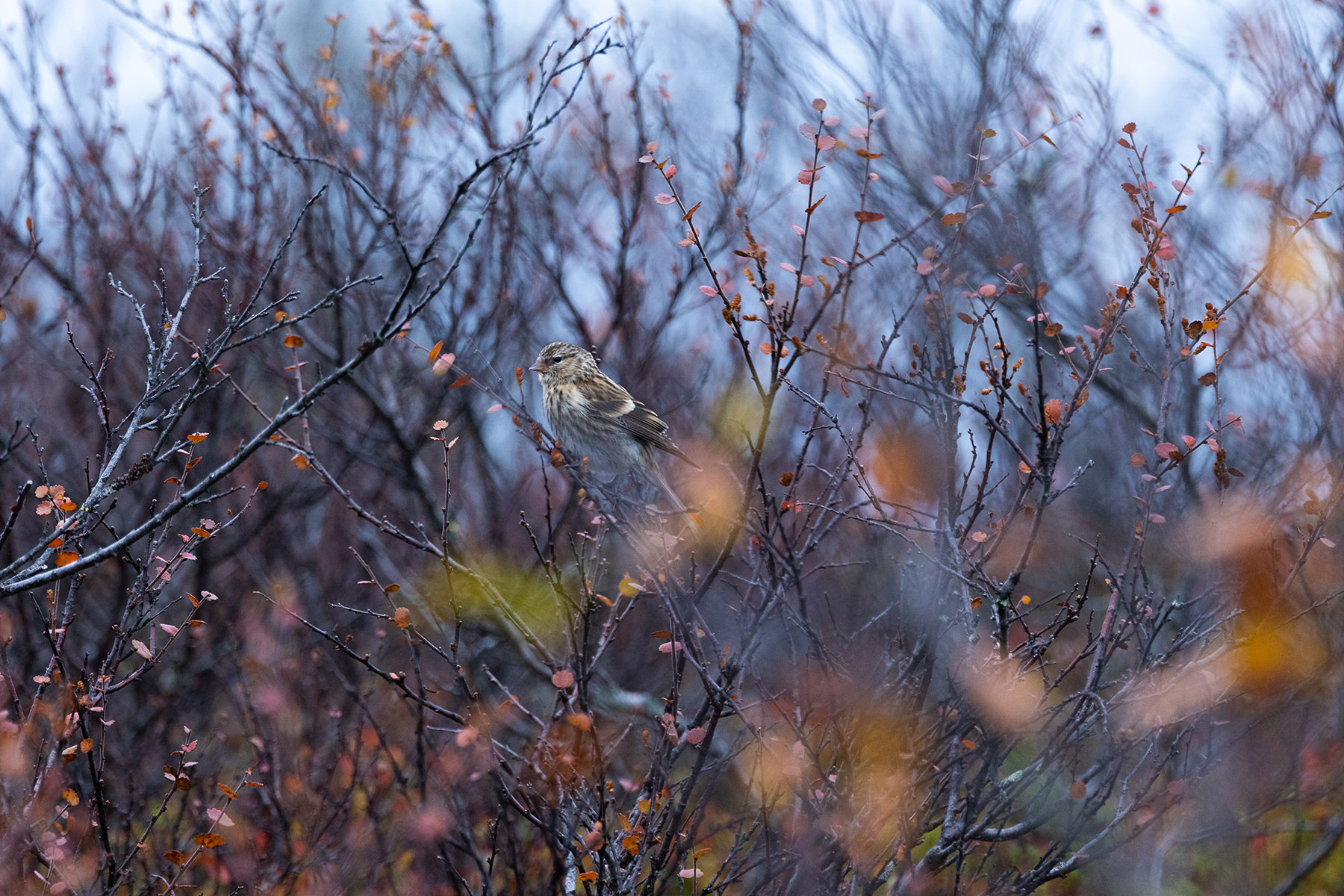
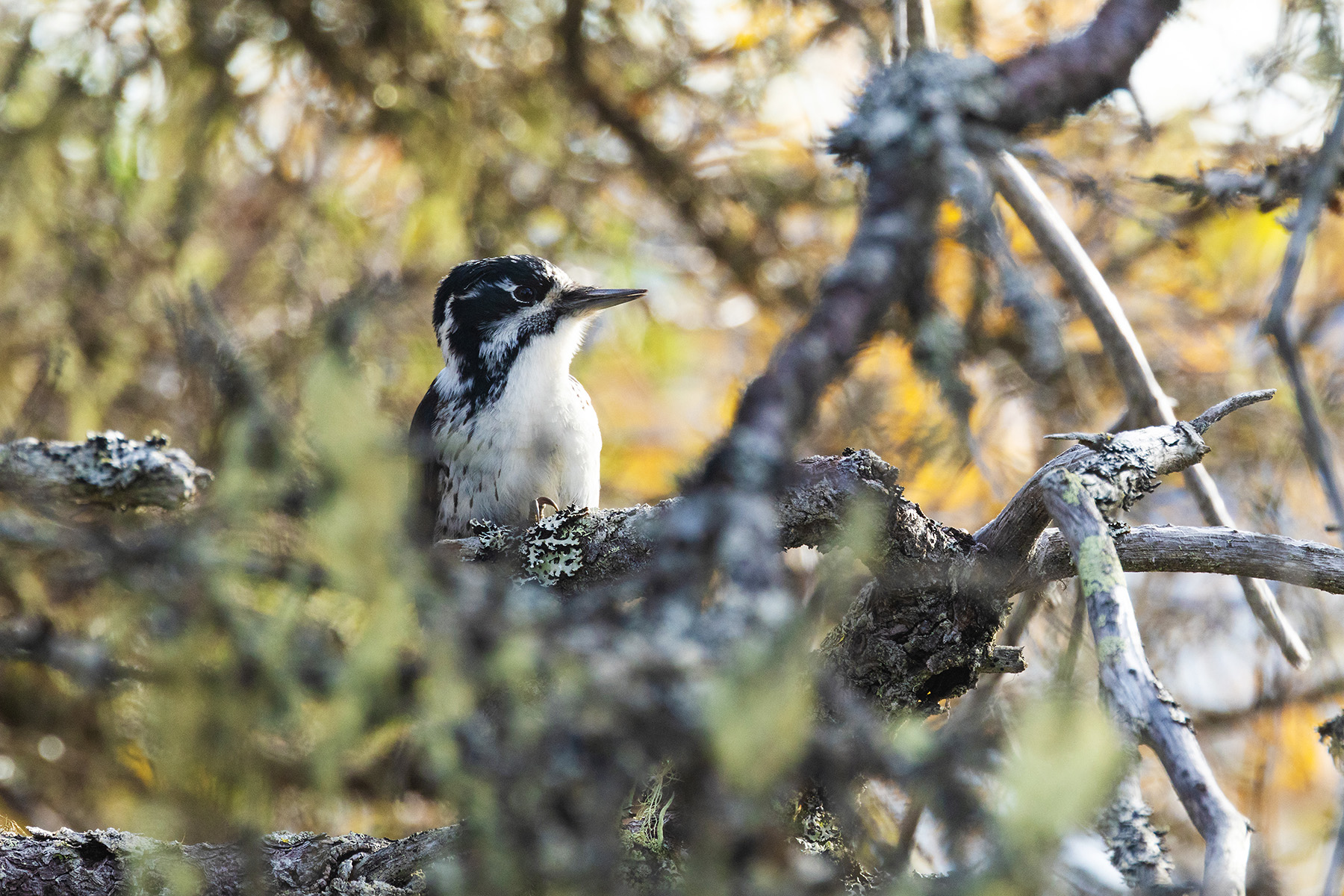
Autumn is the time when the local environment is positively teeming with young birds. The gamebirds are likely led by black grouse, which often display on the autumnally orange patches of bog. Following them, capercaillie frequently appear, and sometimes willow grouse, which acquire a white plumage as the approaching frosts set in. The latter can be spotted both amongst tree trunks and in more open areas, even on the tops of ridges. The greater likelihood of encountering gamebirds is in the early morning, before the vast majority of visitors have set themselves up for Nordic walking or photographing in the national park. Sometimes capercaillie and willow grouse peck small pieces of stone from the paths. No doubt they do this in the evening as well, but so far I haven't happened across them at that time.
In autumn, besides those mentioned above, one can also encounter numerous redpolls, bramblings and thrushes, all of which gather into ever-growing flocks.
The article appeared in edited form in the autumn of 2022 in the magazine Estonian Nature.
Read the story too Riisitunturi in winter and summer.